Motorways
253. Prohibited vehicles. Motorways MUST NOT be used by pedestrians, holders of provisional motorcycle or car licences, riders of motorcycles under 50 cc, cyclists, horse riders, certain slow-moving vehicles and those carrying oversized loads (except by special permission), agricultural vehicles, and powered wheelchairs/powered mobility scooters (see Rules 36-46 incl).
254. Traffic on motorways usually travels faster than on other roads, so you have less time to react. It is especially important to use your mirrors earlier and look much further ahead than you would on other roads.
255. Motorway signals are used to warn you of a danger ahead. For example, there may be an incident, fog, a spillage or road workers on the carriageway which you may not immediately be able to see.
256. Signals situated on the central reservation apply to all lanes. On very busy stretches, signals may be overhead with a separate signal for each lane.
257. Amber flashing lights. These warn of a hazard ahead. The signal may show a temporary maximum speed limit, lanes that are closed or a message such as 'Fog'. Adjust your speed and look out for the danger until you pass a signal which is not flashing or one that gives the 'All clear' sign and you are sure it is safe to increase your speed.
258. Red flashing lights. If red lights on the overhead signals flash above your lane and a red 'X' is showing, you MUST NOT go beyond the signal in that lane. If red lights flash on, a signal in the central reservation or at the side of the road, you MUST NOT go beyond the signal in any lane.
259. Joining the motorway. When you join the motorway you will normally approach it from a road on the left (a slip road) or from an adjoining motorway. You should
- give priority to traffic already on the motorway
- check the traffic on the motorway and match your speed to fit safely into the traffic flow in the left-hand lane
- not cross solid white lines that separate lanes or use the hard shoulder
- stay on the slip road if it continues as an extra lane on the motorway
- remain in the left-hand lane long enough to adjust to the speed of traffic before considering overtaking.
- drive at a steady cruising speed which you and your vehicle can handle safely and is within the speed limit
- keep a safe distance from the vehicle in front and increase the gap on wet or icy roads, or in fog (see Rules 126 and 235).
- any vehicle drawing a trailer
- a goods vehicle with a maximum laden weight exceeding 3.5 tonnes but not exceeding 7.5 tonnes, which is required to be fitted with a speed limiter
- a goods vehicle with a maximum laden weight exceeding 7.5 tonnes
- a passenger vehicle with a maximum laden weight exceeding 7.5 tonnes constructed or adapted to carry more than eight seated passengers in addition to the driver
- a passenger vehicle with a maximum laden weight not exceeding 7.5 tonnes which is constructed or adapted to carry more than eight seated passengers in addition to the driver, which is required to be fitted with a speed limiter.
- check your mirrors
- take time to judge the speeds correctly
- make sure that the lane you will be joining is sufficiently clear ahead and behind
- take a quick sideways glance into the blind spot area to verify the position of a vehicle that may have disappeared from your view in the mirror
- remember that traffic may be coming up behind you very quickly. Check all your mirrors carefully. Look out for motor cyclists. When it is safe to do so, signal in plenty of time, then move out
- ensure you do not cut in on the vehicle you have overtaken
- be especially careful at night and in poor visibility when it is harder to judge speed and distance.
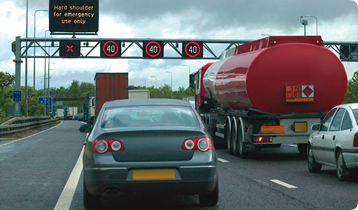
270. You MUST NOT stop on the carriageway, hard shoulder, slip road, central reservation or verge except in an emergency, or when told to do so by the police, HA traffic officers in uniform, an emergency sign or by flashing red light signals. Do not stop on the hard shoulder to either make or receive mobile phone calls.
271. You MUST NOT pick up or set down anyone, or walk on a motorway, except in an emergency.
272. Unless signs indicate that a lane leads directly off the motorway, you will normally leave the motorway by a slip road on your left. You should
- watch for the signs letting you know you are getting near your exit
- move into the left-hand lane well before reaching your exit
- signal left in good time and reduce your speed on the slip road as necessary.
